


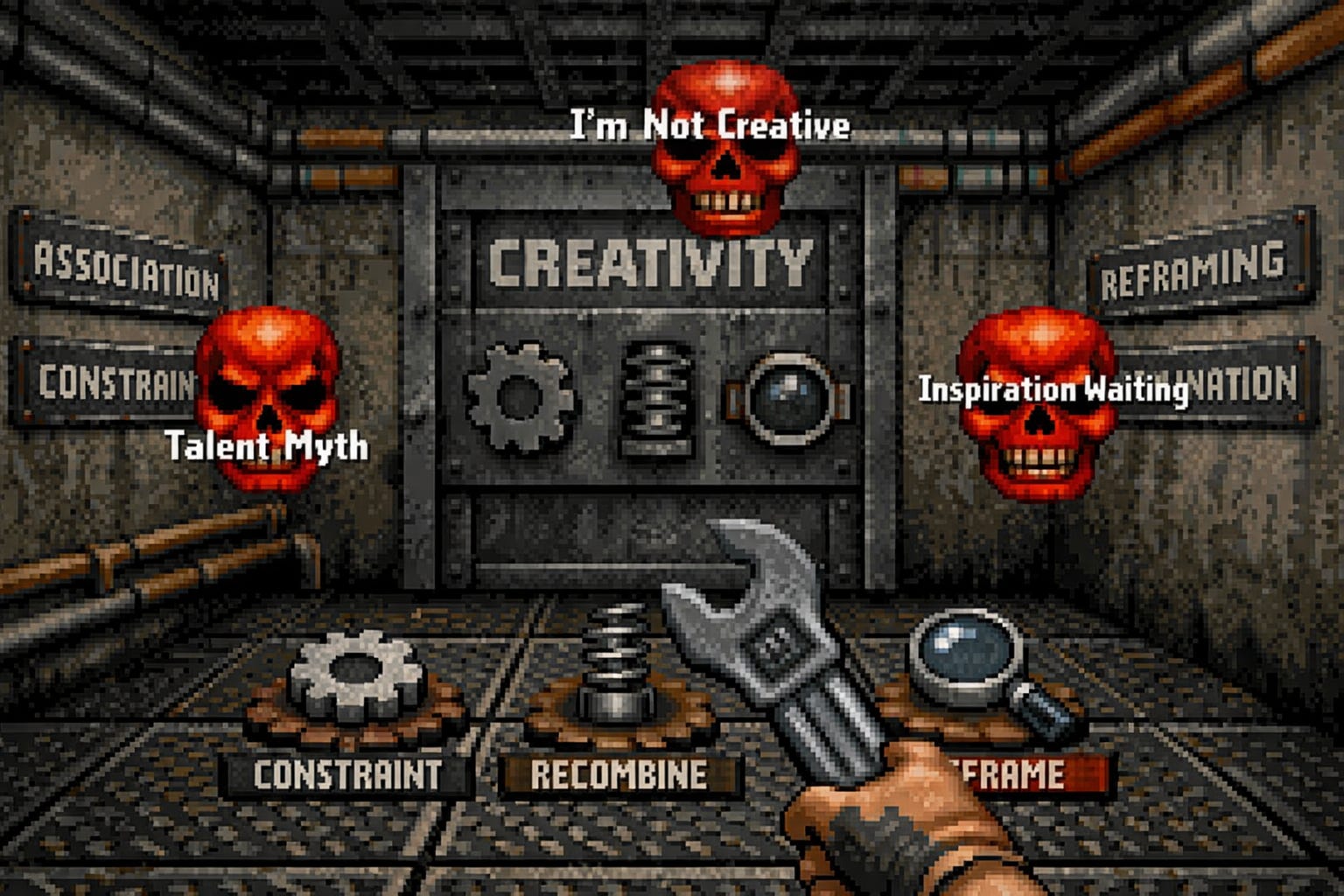
The Situation
This is for operators who believe they’re “not creative.”
Founders who can model a market but struggle to frame a narrative.
Product leaders who can architect systems but default to safe messaging.
Marketing teams who produce accurate work that nobody remembers.
Creative thinking feels mysterious because we see outputs, not process. The result looks intuitive. The method looks invisible.
So people wait for ideas instead of building them.
What People Think Is Happening
The dominant myth:
Creativity is talent.
Talent is innate.
Some people have it.
Most don’t.
So when ideas don’t appear instantly, the conclusion is personal deficiency.
That diagnosis is wrong.
What’s Actually Happening
Creative thinking is the deliberate manipulation of content worlds and context elements.
It’s the deliberate manipulation of:
Content worlds (finance, war, childhood, marriage, sports, religion, technology)
Context elements inside those worlds (contracts, rings, uniforms, drills, rituals, servers, scoreboards)
Creativity emerges when you:
Separate worlds from their internal components
Recombine elements across domains
Invert assumptions
Introduce contrast
Remove expected closure
It is structural recombination under constraint.

The Framework
1. Separate Content From Context
First, isolate the world. Then break it into parts.
Example: Marriage as a content world
Context elements:
Ring
Vows
Ceremony
Contract
Shared bank account
In-laws
Now those components are modular.
That modularity is powerful.
Real-world case: HubSpot’s “Inbound” framing
Early B2B marketing software was framed in engineering language: funnels, campaigns, automation.
HubSpot reframed the category around “attraction.” They borrowed from dating and magnetism rather than enterprise IT.
Blog posts became “courtship.” Leads were “relationships.” The methodology became “Inbound.”
They separated the SaaS tooling world from its technical vocabulary and transplanted relational language into it. The category shifted.
Separation creates modularity. Modularity enables recombination.
2. Inversion and Contrast
Inversion creates tension. Tension creates attention.
Ask:
What’s the default framing?
What’s the opposite?
What if the opposite is normal?
Real-world case: Liquid Death
Water is framed as purity, health, and calm.
Liquid Death inverted it. Tallboy cans. Heavy metal branding. “Murder Your Thirst.”
They treated hydration like a punk album.
The product did not change. The framing did.
Without contrast, everything is beige.

3. Map Associations: Closest to Farthest
Take a concept and map associations from predictable to distant.
If the concept is “enterprise security”:
Closest: firewalls, compliance, SOC2.
Mid-range: insurance, risk mitigation, seatbelts.
Far: airport security theater, TSA lines, body scanners.
The most interesting work usually sits at the edge of coherence.
Example: Gong
Instead of saying “revenue intelligence software,” Gong leaned into sports commentary language. “Deal intelligence.” “Win rates.” “Coach your reps.”
They moved from software language to locker room language.
That far-edge association created memorability without losing relevance.
4. Cross-World Transplantation
Take an element from one content world and use it unchanged in another.
Example: Apple’s 1984 Launch
The content world: personal computing.
The transplanted world: dystopian rebellion.
The Ridley Scott–directed “1984” Super Bowl ad didn’t compare IBM to Big Brother casually. It used Orwell’s authoritarian structure wholesale: conformity, oppression, lone rebel, hammer throw.
The product launch became a regime change.
Hybrid combinations also work. When two worlds merge organically, neither feels decorative. The result becomes its own internal logic.

5. Narrative Manipulation and Omission
The brain wants closure. Use that bias.
Lead toward an obvious conclusion, then twist.
Remove one key detail and let the audience infer it.
Leave the punchline unsaid.
Use rhetorical questions that force mental completion.
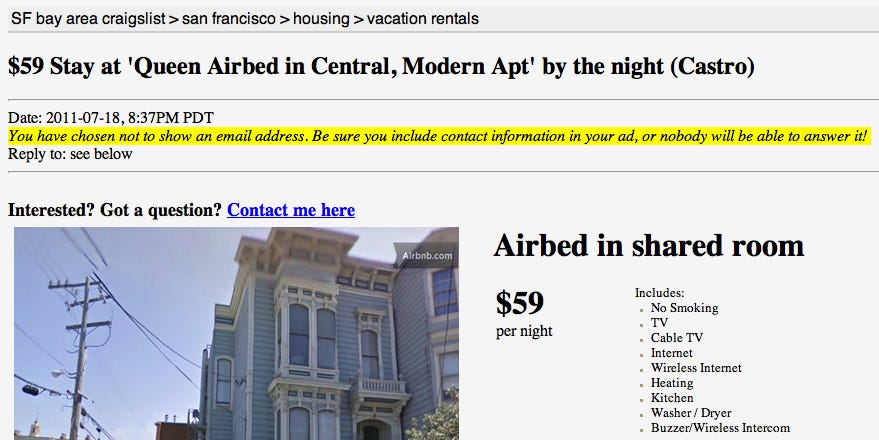
Example: Airbnb’s Early Craigslist Hack
When Airbnb seeded listings into Craigslist, the narrative looked like individual hosts discovering a new side-income channel. The infrastructure story was invisible.
The public-facing narrative was organic growth.
The structural engine was mechanical distribution.
The omission preserved the illusion of inevitability.
On a smaller scale, this is what great product launch videos do. They show the pain before the category name. They let the viewer infer the solution before labeling it.
Completion builds retention.
Example
You’re writing about financial discipline.
Default messaging:
“Invest early. Compound interest matters.”
Correct. Forgettable.
Structural rewrite:
Content world: Fitness.
Context elements: reps, soreness, schedule, progressive overload.
Transplant:
“Your portfolio doesn’t care about motivation. It cares about reps.”
Now build a story about someone who trains daily. Strict calendar. Measured progression. No skipped days.
Final reveal: They’re not describing a body transformation. They’re describing an automated monthly index fund.
The audience reconstructs the story retroactively.
That reconstruction is the memory mechanism.
This is why Nike’s “Just Do It” worked structurally. It borrowed the grammar of discipline and repetition, not just athleticism. The slogan functions in fitness, entrepreneurship, education, and recovery because it lives in the structure of effort.
The Test
This applies to you if:
Your work is clear but rarely memorable.
Your team defaults to obvious metaphors.
Creative reviews sound like “this works” instead of “this hits.”
You over-explain instead of trusting inference.
Take your next piece of communication and force:
One inversion.
One cross-world transplant.
One removed explanatory sentence.
If the output feels sharper and slightly uncomfortable, you’re operating structurally.