



The Situation
This is for founders, growth leads, and performance marketers who are spending real budget across paid search, paid social, and maybe some programmatic, yet growth feels fragile.
CAC moves unpredictably. Channels “fatigue.” Meta works, then doesn’t. Google converts but doesn’t scale. LinkedIn is expensive but “strategic.” Everyone argues attribution. No one trusts the numbers.
So the natural reaction is to tweak creatives, test new channels, hire a better media buyer, or blame signal loss.
Sometimes that helps. Often, it’s just rearranging surface variables.
What People Think Is Happening
Most teams believe performance marketing success depends on:
Better creatives
More granular targeting
Smarter bidding strategies
Finding the next arbitrage channel
Fixing attribution models
These matter. But they are surface optimizations.
When performance stalls, the assumption is: the channel is saturated, competition increased, or the algorithm changed.
Sometimes true. Often convenient.
What’s Actually Happening
Performance marketing is an output of system coherence across four layers:
Market-message fit
Funnel physics
Measurement integrity
Capital allocation logic
If any layer is structurally weak, no amount of creative testing will save you.
Paid media amplifies what already exists. It does not fix it.
If conversion rates are low, it might not be creative quality. It might be weak positioning.
If CAC is unstable, it might not be bidding strategy. It might be misaligned LTV assumptions.
If scaling breaks efficiency, it might not be channel fatigue. It might be marginal audience decay interacting with poor qualification.
Performance marketing is not a channel game. It’s a systems stress test.
The Framework
1. Diagnose Market-Message Fit Before Touching Media
Before scaling spend, answer:
Is the value proposition clear to a cold audience?
Are we solving an urgent, budget-backed problem?
Does our positioning filter out the wrong buyers?
If your sales team constantly “educates” prospects on what you do, paid traffic will underperform.
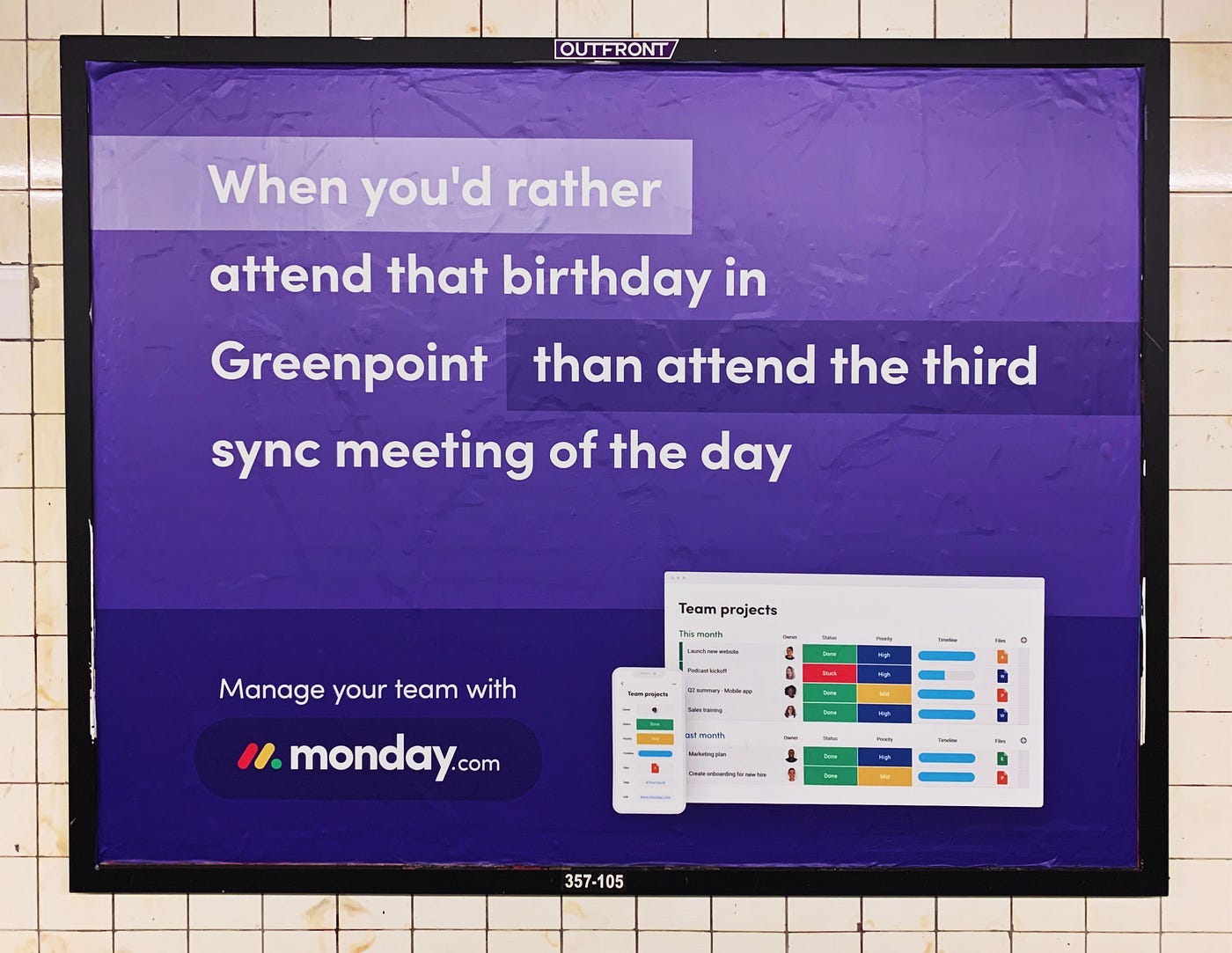
Look at Monday.com in its early hypergrowth phase (and immense marketing operation). Their ads didn’t just say “work management platform.” They showed concrete use cases - marketing planning boards, content calendars, dev sprints. The message was tangible. Cold audiences could immediately map it to their daily chaos.
Contrast that with generic SaaS ads promising “AI-powered workflow optimization.” That may generate clicks. It rarely generates qualified pipeline.
Strong market-message fit shows up as:
Healthy non-branded search CTR
Solid cold paid social CVR
Low bounce rates on first-touch pages
If those aren’t present, the issue is upstream. Fix positioning.
2. Respect Funnel Physics
Every funnel has structural constraints:
Click-through rate
Landing page conversion rate
Sales acceptance rate
Close rate
Average deal size
Multiply them and you get revenue per impression.
If your landing page converts at 2% and your close rate is 10%, you need 500 clicks per deal.
Performance marketing strategy must start with funnel math. It breaks at scale because inefficiency compounds faster than budget.
3. Separate Signal from Story in Attribution
Attribution debates are often emotional.
Sales wants credit for everything.
Marketing wants last-click.
Leadership wants blended CAC.
Instead, define measurement by decision type:
Channel optimization → platform-level signal is enough.
Budget allocation → blended CAC by source cluster.
Strategic planning → cohort-based LTV:CAC by motion.
Do not use one metric for all decisions. That’s how teams end up distrusting everything.
Attribution should serve capital allocation, not internal ego management :)
4. Allocate Budget by Marginal Efficiency
Most teams scale what feels safe.
But performance marketing strategy is a capital allocation problem.
Consider Airbnb during early growth. They famously reduced paid search dependency and reallocated budget toward SEO and product-led loops when marginal returns from paid flattened. It wasn’t ideological. It was economic.
Every incremental dollar should be evaluated on:
Marginal CAC
Payback window
LTV stability
Strategic dependency risk
5. Close the Loop with Product and Sales
If paid leads churn quickly, the issue may be:
Misaligned expectations set by ads
Overpromising creative
Wrong ICP targeting
Weak onboarding
Performance data must flow back into:
Positioning refinement
ICP narrowing
Product onboarding
Sales qualification criteria
If performance marketing operates in isolation, efficiency will degrade over time. Always.
Example
A B2B SaaS company selling workflow automation is spending $150k/month across Google and LinkedIn.
Symptoms:
CAC creeping up 25% quarter-over-quarter
Sales complaining about lead quality
Marketing testing new creatives every week
Surface diagnosis: ad fatigue and increased competition.
Actual issue:
Messaging focused on “automation” broadly.
Sales only closing mid-market operations teams with compliance complexity.
Paid campaigns targeting generic productivity keywords.
The channel didn’t fail. The targeting and positioning were misaligned with the actual high-LTV segment.
Fix:
Reposition around compliance-driven automation.
Narrow targeting to regulated industries.
Build landing pages specific to operations leaders.
Adjust budget toward high-intent compliance search clusters.
Result:
Lower lead volume. Higher close rate. Stable blended CAC.
Performance didn’t improve because the media buyer got smarter. It improved because the system got coherent.
The Test
You likely have a structural performance marketing problem if:
CAC fluctuates heavily with minor spend changes.
Sales rejects more than 30% of paid leads.
Scaling spend reduces close rate.
No one can clearly explain your revenue per impression math.
Budget allocation decisions rely on historical comfort rather than marginal analysis.
If three or more are true, creative testing is not your bottleneck. Your architecture is.