


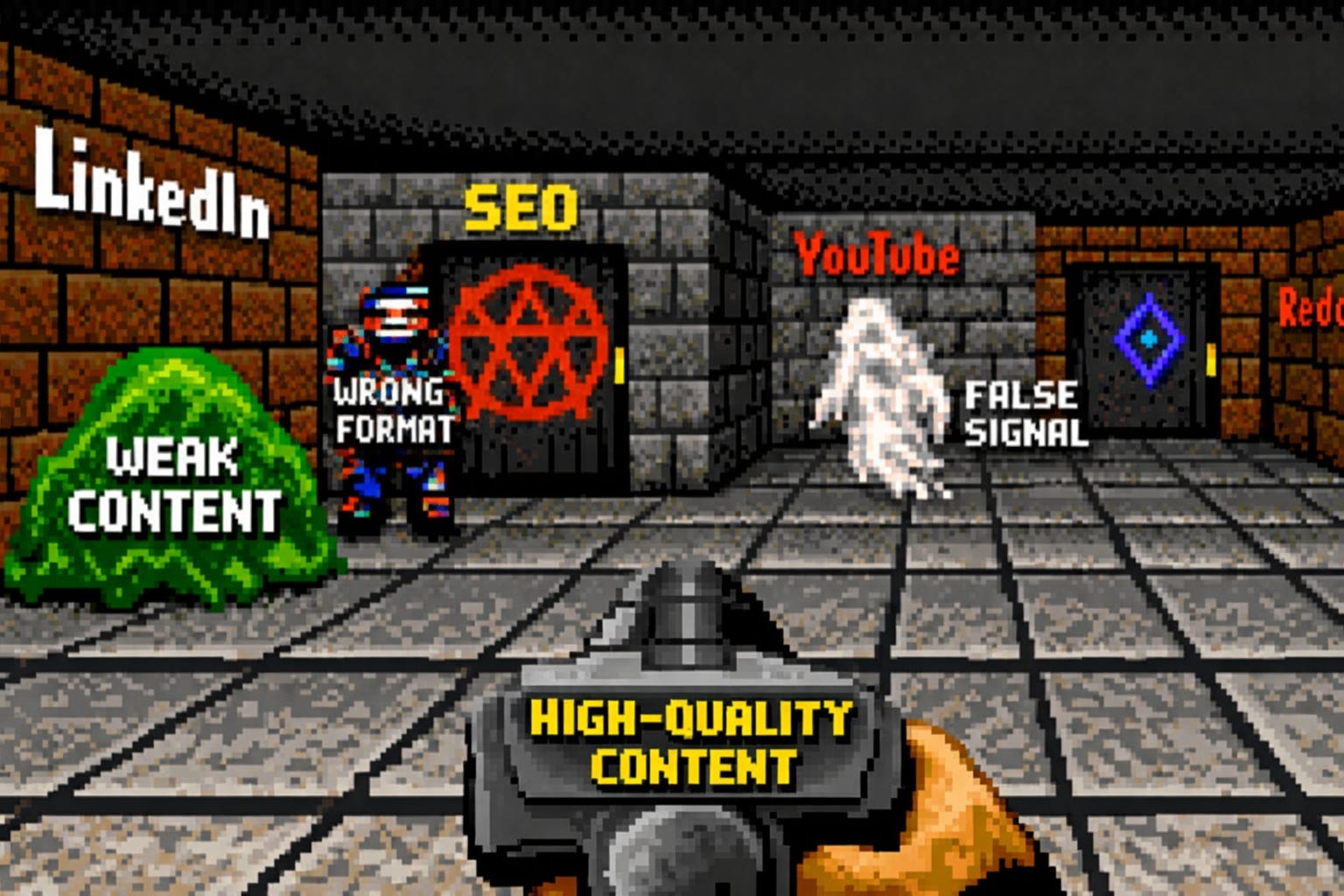
The Situation
You’re building the marketing foundation from zero, or close to it. No clear acquisition engine, no reliable baseline, and too many opinions about “what works.”
Everyone asks the same question: which channels should we start with?
It sounds simple, but it isn’t. Early channel choices are one of the highest-leverage decisions you’ll make. They shape how your company learns, how fast it learns, and what kind of momentum it can build.
Most teams either lock into a couple of channels too early, or scatter effort across too many without structure. Both paths tend to end the same way: weak signals, unclear conclusions, and channels getting written off too soon.
What People Think Is Happening
Channel selection is usually framed as a picking exercise:
Choose 1–2 channels where your audience “is”
Follow what competitors are already doing
Spend time setting up the “right” motion before launching
There’s also a subtle assumption that channels are foundational decisions, not something you revisit frequently.
So you hear things like:
“Our audience is on LinkedIn, so that’s our main channel”
“SEO takes time, so we’ll start there”
“Paid didn’t work for us”
It feels structured. It feels thoughtful.
But the underlying assumption is off. The question isn’t where you think your audience is, it’s where they’ll actually pay attention to you, right now, in your current form.
What’s Actually Happening
Early marketing behaves less like selection and more like exploration.
The goal at this stage is not to identify the “right” channel. It’s to create enough surface area to learn which ones are wrong.
That requires starting broader than most teams are comfortable with.
Two structural realities tend to get missed:
Audience presence ≠ attention
Your audience might exist on a platform. That doesn’t mean they’ll engage with you there. Attention has to be earned in-context.Channel performance is tightly coupled to content quality
Many early “channel failures” are just low-quality or misfit content being exposed to the market.
So when a channel gets labeled as ineffective, what’s actually been tested is much narrower: This version of this idea, expressed this way, on this platform.
That’s a thin slice of reality and not a reliable conclusion.
The Framework
1. Separate “Certain” vs “Possible” Channels
Start by mapping two distinct buckets (example):
Where your audience surely is
LinkedIn for B2B operators
GitHub or Hacker News for developers
Google Search for high-intent problems
Where your audience might be
Reddit threads
Niche communities
YouTube formats
Newsletters
Emerging or less obvious platforms
This creates a working field of channels to explore.
Early on, coverage matters more than precision - deliberately wide.
2. Treat Channels as Hypotheses
Each channel carries a set of assumptions:
Can attention be earned here?
Does that attention translate into action?
Can you keep showing up here consistently?
To make that test meaningful, each channel needs structure:
A defined content format
A specific audience slice
A clear success signal
Without that, activity looks like progress, but doesn’t produce learning.
3. Overinvest in Content Quality (Early)
This is where most early channel decisions fail.
Before concluding anything about a channel, the content needs to reach a bar where you can stand behind it without hesitation. You have to invest time here.
That usually means:
Multiple creative variations around the same idea
Strong hooks that compete for attention, not just deliver information
Formatting that feels native to the platform
Enough effort that the result reflects real intent, not placeholder output
When that bar isn’t met, channels get ruled out for the wrong reason.
4. Build Platform-Native Content
The same underlying idea can travel across channels, but the expression has to change.
Each platform has its own expectations:
LinkedIn → narrative, perspective, identity
Twitter/X → compression, sharp edges, repeatability
YouTube → pacing, retention, visual payoff
Reddit → credibility, tone awareness, low promotion
SEO → clarity, intent matching, structured answers
Take a single product insight:
It might become a story on LinkedIn
A sharp, contrarian thread on X
A walkthrough video on YouTube
A detailed guide for search
When the same asset is copied across platforms, the test becomes inconclusive. It’s hard to tell whether the channel underperformed, or the format simply didn’t belong there.
5. Measure Signals, Not Just Outcomes
Early-stage evaluation benefits from looking beyond conversions.
The more useful signals tend to show up earlier:
Attention quality
View-to-impression ratios
Depth of engagement (comments, not just likes)
Watch time or retention
Message resonance
People reusing your language
Tags and shares with context
Inbound messages referencing specific ideas
Conversion signals
Click-through rate
Conversion rate
Cost per meaningful action
Sustainability
Can content be produced consistently?
Does performance improve with iteration?
Does the channel compound over time?
Patterns matter more than single outcomes. A channel starts to stand out when engagement feels intentional and improves as you learn.
Example
qbiq (Category Emergence Through Breadth)
Starting broad across channels created early visibility across multiple surfaces: LinkedIn for thought leadership, SEO content for intent capture, and visual formats where architectural outputs could be demonstrated (Instagram, Youtube).
Each platform was explored with native content, qbiq became recognizable within “AI for architectural planning” as a category. The breadth created coverage, then brand dominance.
Notion (Multi-Surface Exploration)
Early Notion growth spanned Product Hunt launches, Twitter threads, community-built templates, and YouTube explainers.
The template gallery in particular matched how users wanted to engage.
Figma (Community-Led Distribution)
Figma embedded itself inside design communities, enabling sharing through files and templates.
Content didn’t sit outside the product. It lived inside usage.
Wiz (Layered Channel Execution)
Wiz combined physical campaigns, social amplification, and community loops.
The effectiveness came from alignment - the idea, the format, and the channel reinforced each other.
The Test
You’re likely still early in channel exploration if:
Only one or two channels have been tested with real depth
The same content is being reused across platforms
Each channel has only a handful of attempts behind it
Conclusions are being drawn without strong creative inputs
It’s difficult to explain what actually drove a result
Progress starts to show when:
Each channel has a clear hypothesis behind it
There are examples that almost worked, not just clear wins or losses
Formats begin to feel native to the platform
Content quality feels slightly uncomfortable relative to stage