


The Situation
This is for founders and GTM leaders preparing to come out of stealth, especially in B2B, deep tech, infra, or complex product categories.
You’ve built for 12–24 months. The product is finally stable. The instinct is to “announce,” maybe line up a PR hit, maybe a Product Hunt launch, maybe a LinkedIn post from the founder.
It feels like a marketing milestone, when it’s really a GTM inflection point.
What People Think Is Happening
Most teams think an out-of-stealth launch is:
A press cycle
A brand awareness moment
A chance to “make noise”
A credibility event for investors
A short spike in traffic
So they optimize for:
Coverage volume
Social impressions
Website visits
Launch-day signups
Then momentum disappears in 10 days.
Everyone shrugs. “Launches don’t matter anymore.”
What’s Actually Happening
An out-of-stealth launch is not a marketing announcement.
It is a liquidity event for attention.
You get one moment where:
Investors amplify
Customers are curious
Talent is paying attention
Media is receptive
Competitors are watching
Your own team is emotionally aligned
This is the only moment where attention density is temporarily compressed in your favor.
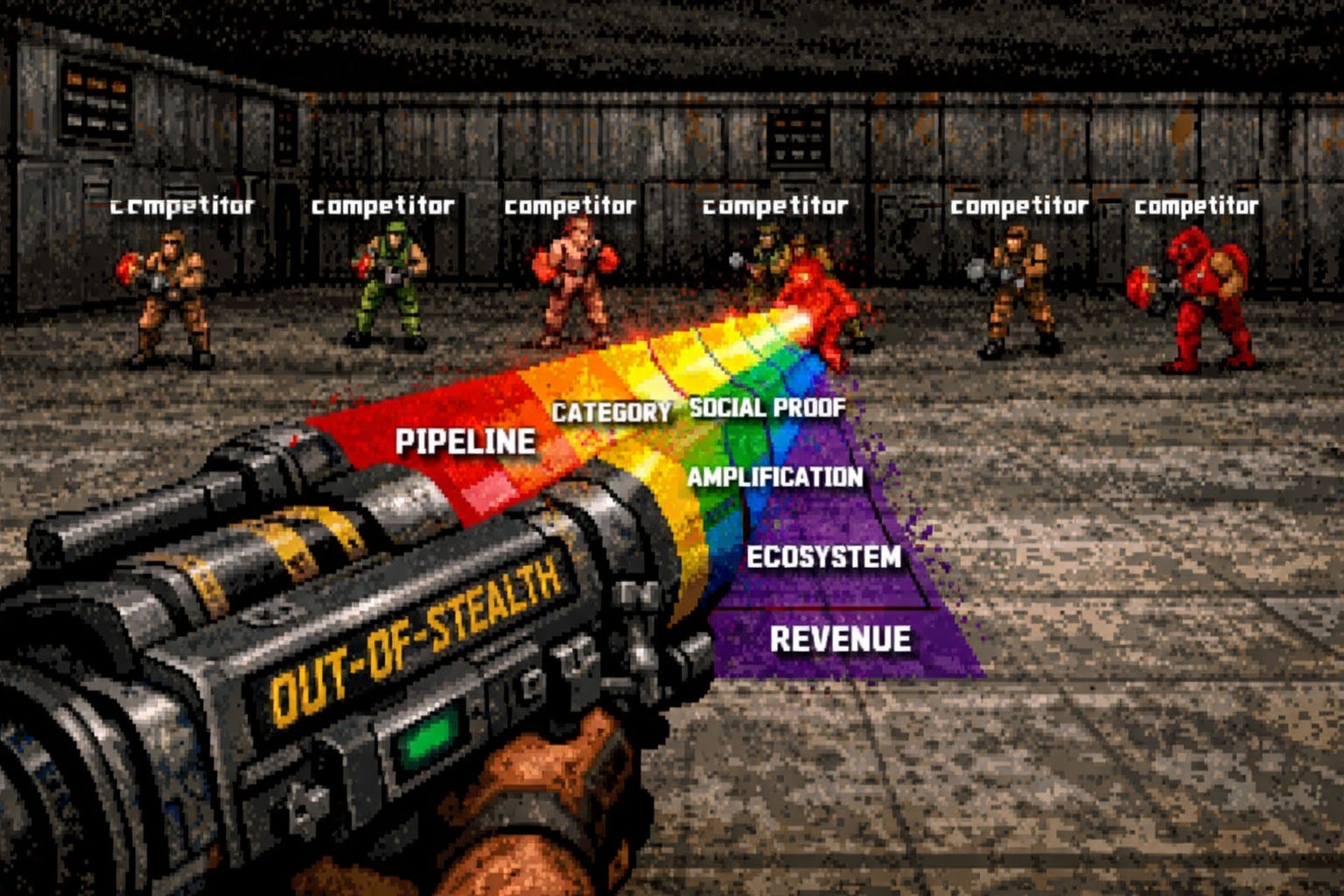
If you don’t convert that density into:
Pipeline
Narrative dominance
Ecosystem gravity
Social proof assets
Reusable distribution loops
you burn it.
Launch is about creating momentum that provides real-world business impact.
The Framework
1. Design for Aftershock, Not Day One
Launch day is irrelevant when measuring results. Weeks 2–8 matter.
Ask:
What happens 14 days after the press?
What artifact keeps circulating?
What repeatable motion begins here?
Examples of structural aftershock mechanisms:
Open datasets
Public benchmarks
Annual reports
Founder POV series
Customer co-launches
Ecosystem partnerships
If nothing continues moving after the announcement, you didn’t launch. You posted.
2. Convert Attention Into Permanent Assets
Attention is temporary. Assets are compounding.
At launch, aim to create:
Case studies
Market category language
Industry definitions
Proprietary frameworks
Community entry points
Sales enablement artifacts
3. Collapse Narrative Ambiguity Immediately
The first 30 days post-launch determine how the market files you mentally.
Are you:
A feature company?
A tool?
A category?
A platform?
A security layer?
An AI wrapper?
If you do not define yourself clearly and repeatedly, analysts, media, and competitors will define you.
Out-of-stealth is your only clean narrative slate.
The stage is yours. Use it.
4. Activate Distributed Amplification
The most underused lever in out-of-stealth launches is coordinated amplification.
This means:
Investor networks posting coordinated POV
Customers announcing partnerships
Advisors publishing endorsements
Employees sharing synchronized content
Community allies amplifying within niche ecosystems
One founder post is not momentum.
Thirty aligned nodes moving together is.
Momentum is networked.
5. Tie Launch to Revenue Motion Immediately
The biggest mistake: separating launch from pipeline.
Launch without a revenue trigger is theater.
At launch, you should already have:
Lighthouse customers ready to be named
A defined ICP and outbound sequence
Sales scripts aligned to press narrative
Clear call-to-action beyond “learn more”
The best launches accelerate active deals.
If your sales team can’t reference the launch in live calls that week, the launch is disconnected from GTM.
Examples
Snowflake
When Snowflake emerged from stealth, it didn’t position itself as “a better database.”
It framed cloud data warehousing as structurally different from legacy systems. Over time, its annual Data Cloud Summit became narrative reinforcement. Launch wasn’t noise. It was the beginning of a category arc.

OpenAI (ChatGPT moment)
ChatGPT’s public release wasn’t framed as a product update. It was an accessibility unlock. The launch converted attention into developer ecosystem expansion, plugin frameworks, enterprise trials, and massive earned distribution. The aftershock mattered more than day one.

The Test
Your launch has structural momentum if:
Sales velocity increases within 30 days
Inbound quality improves, not just volume
Investors use your narrative language publicly
Competitors start referencing your framing
Analysts include you in category discussions
Hiring conversion rates rise
You can point to reusable assets created at launch
If all you can show is website traffic from week one, you ran a campaign, not a launch motion.