


The Situation
This is for founders, marketing leaders, product marketers, sales leaders, and category builders who are stuck in a familiar loop.
The website has been rewritten.
The deck has been “tightened.”
The narrative has been workshopped until everyone involved has lost the ability to speak like a person.
And still, the market does not move.
Prospects understand the words. That is the annoying part. They are not confused in the basic sense. They can repeat the category, the use case, the pain, and the promised outcome. Then they go quiet, delay the pilot, ask for another stakeholder, or choose the incumbent that everyone privately complains about.
This is where market proof matters.
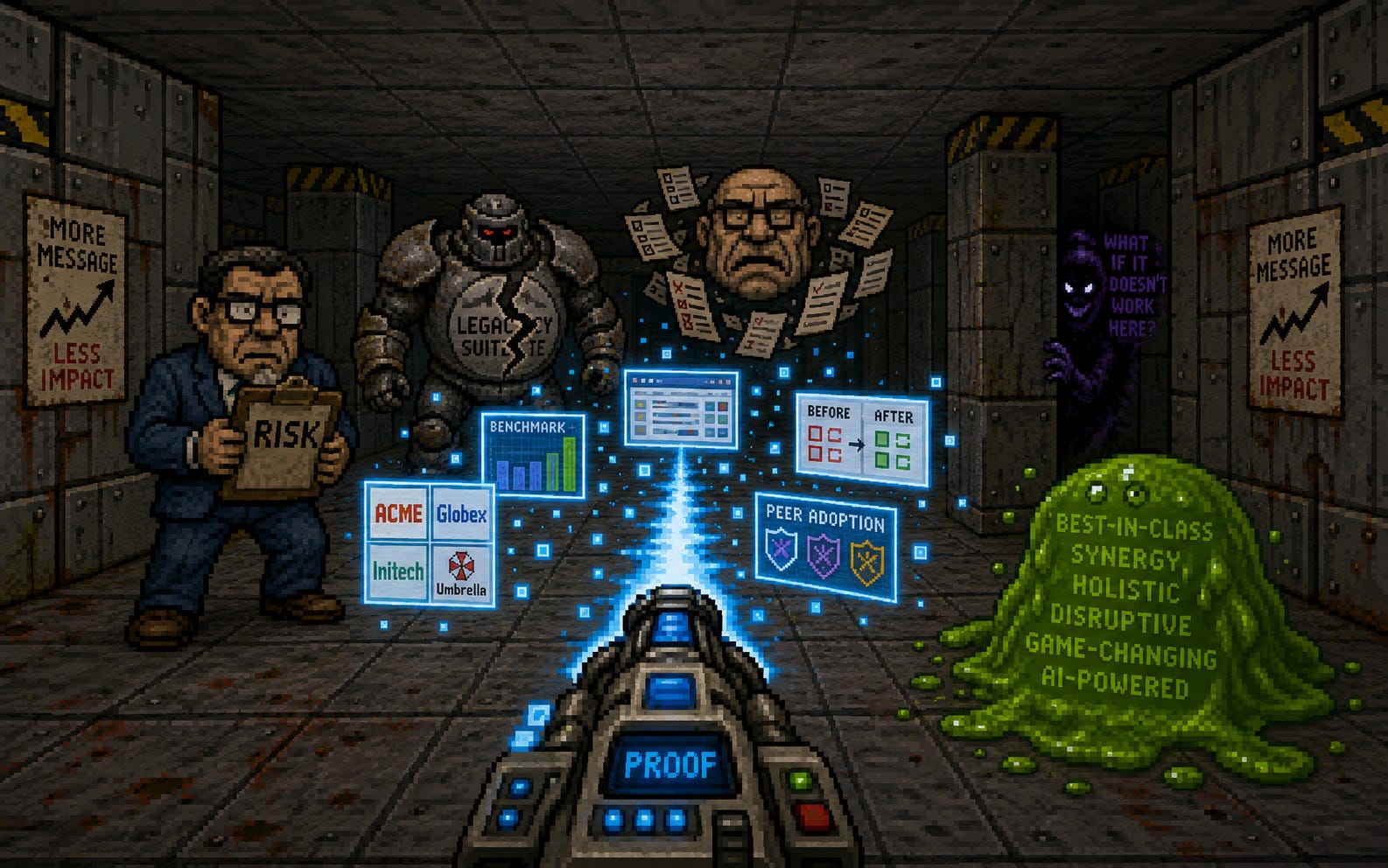
Market proof is the visible evidence that makes your claim feel safe to believe. It is not a testimonial widget. It is not a logo strip. It is not “trusted by leading teams,” which is usually where credibility goes to take a nap.
It is the operating layer between positioning and adoption.
In complex GTM, especially in B2B, deep tech, infrastructure, security, data, and anything sold into risk-sensitive environments, belief is not created by clarity alone. Clarity helps people understand what you mean. Proof helps them justify acting on it.
That distinction is small, and expensive.
What People Think Is Happening
Most teams diagnose weak demand as a messaging problem.
The pitch is not sharp enough.
The category is not clear enough.
The ICP is not narrow enough.
The homepage does not “pop.”
The sales deck needs a stronger opening slide, ideally one with fewer words and more gradients. fine.
Sometimes that is true.
Bad messaging can absolutely bury a good product. A vague category, lazy differentiation, or bloated enterprise copy will slow everything down. But many teams are not losing because the market cannot understand them. They are losing because the market does not yet have enough external evidence to trust the claim.
So the team keeps improving the sentence.
They should be improving the proof environment around the sentence.
This shows up everywhere:
A startup says it is “the modern data control plane,” but buyers cannot see who has switched, what changed operationally, or why the old model is breaking.
A cybersecurity company says it “reduces risk across cloud environments,” but the proof is trapped in private sales calls, case studies, and bland analyst quotes.
A devtools company says developers love it, but the only visible evidence is a GitHub star count, a few Discord screenshots, and a testimonial from someone with the job title “Advisor.”
The claim may be right.
The market just has no reason to carry it for you.
What’s Actually Happening
GTM teams often confuse message clarity with belief formation.
Message clarity answers, “What are you saying?”
Belief formation answers, “Why would a serious buyer risk agreeing with you?”
That second question is heavier.
A buyer who believes you may need to change vendors, rewrite process, spend political capital, introduce new technical risk, defend the decision in procurement, and explain why the old approach is now insufficient. In B2B, adoption is rarely just preference. It is an internal argument.
Your GTM assets need to help the buyer win that argument.
This is why strong companies build visible proof systems. They create artifacts, public signals, customer evidence, usage patterns, benchmarks, community behavior, and market moments that make the desired belief feel increasingly normal.
Slack did not only say work communication was broken. It let teams experience the product quickly, then turned customer affection into public proof through social sharing, customer quotes, and visible workplace adoption.
Figma did not only position itself as collaborative design software. Its multiplayer experience created proof inside the product itself: designers, product managers, and engineers could literally see collaboration happening in the same file.
The pattern is: make the market witness the shift.
The Framework
1. Turn Claims Into Evidence
Most positioning statements are claims pretending to be strategy.
“We help teams ship faster.”
“We make security continuous.”
“We unify customer data.”
“We automate manual workflows.”
These are not wrong. They are just underpowered.
Every major claim needs an evidence system behind it. The question is not, “Is this sentence clear?” The question is, “What proof makes this sentence hard to dismiss?”
A useful test:
For every core claim, list the evidence that supports it.
If the claim is speed, show before-and-after workflow time.
If the claim is trust, show adoption by conservative buyers.
If the claim is technical superiority, show benchmarks, architecture diagrams, migration patterns, or failure modes in the old approach.
If the claim is market momentum, show public usage signals, community growth, ecosystem pull, or customer-generated artifacts.
The best GTM teams do not leave proof inside the product, the CRM, or the founder’s head. They package it.
2. Make Risk Socially Smaller
In complex buying environments, one of the buyer’s hidden questions is: “Will I look stupid if I believe this?”
That sounds crude. It is also very real.
A buyer can like your product and still avoid the decision if the belief feels lonely. New categories are especially vulnerable here. The first believers need protection. They need signals that other competent people are reaching the same conclusion.
This is why customer logos work, but only when they are specific enough to reduce perceived risk.
A row of logos says, “Some companies bought this.”
A named customer story says, “Someone like you had this problem, made this decision, survived the internal politics, and got a result.”
Better.
A public migration story is stronger still. It shows movement. It makes the buyer feel like the market has a direction.
This is also why categories often accelerate once the proof becomes peer-visible. Not necessarily because the product suddenly improved, but because the belief became safer.
Think about how Atlassian built trust for Jira and Confluence across technical teams. A lot of adoption did not begin with polished executive persuasion. It spread through visible team usage, internal referrals, and the simple fact that practitioners could point to other serious teams already working that way.
The proof did not need to be glamorous. It needed to be portable.
For operators, the lesson is slightly uncomfortable: sometimes your buyer does not need more conviction. They need more cover.
3. Build Proof Where Attention Already Exists
A common mistake is treating proof like a library.
The team creates case studies, analyst reports, testimonials, sales slides, review-site quotes, customer videos, benchmark PDFs, and maybe a “Resources” page where good assets go to slowly compost.
Proof that sits quietly is not a GTM system. It is storage.
Strong proof is placed where decisions are already being shaped:
On the homepage, near the riskiest claim.
In sales decks, before the buyer asks for validation.
In outbound, as a reason to respond.
In onboarding, to reinforce that the user made a smart choice.
In community, where peers can repeat it.
In category content, where the old way is being questioned.
In product surfaces, where usage itself can become evidence.
Stripe’s documentation has played a similar role. For years, the docs themselves were part of the proof. Clean examples, thoughtful API design, and developer-first clarity made the positioning tangible. Stripe did not need to keep saying “we care about developers” if developers could feel it in the implementation path.
The point is simple: proof should appear at the moment doubt forms.
Not three clicks later in a gated PDF.
4. Give Sales Proof They Can Actually Use
Sales teams do not need more brand adjectives.
They need proof artifacts that survive real conversations.
A good proof artifact can be used in a live call, forwarded after the meeting, dropped into a procurement thread, shared internally by a champion, or used to reframe a competitor comparison.
Most marketing teams underbuild this layer.
They create polished assets that look good in campaign reviews but are too soft for sales motion. The sales team then creates its own proof in fragments: screenshots, messy customer anecdotes, objection-handling docs, snippets from Slack, half-updated slides, and one cursed Google Doc called “good stuff.”
That chaos is often a signal. Sales has found the proof the market actually needs. Marketing just has not operationalized it yet.
The useful proof assets are usually concrete:
A teardown of the old workflow.
A “before and after” implementation map.
A competitive displacement story.
A benchmark with clear caveats.
A customer rollout timeline.
A CFO-friendly cost-of-delay model.
This is where deep tech GTM often fails. The product may be genuinely differentiated, but the proof stays too technical for executives and too abstract for practitioners. The buyer needs a bridge between architectural advantage and business consequence.
5. Make the Market Repeat the Proof
The highest form of proof is not the asset you publish.
It is the sentence the market repeats without you in the room.
This is why the best proof systems create repeatable language and visible artifacts.
Salesforce had “No Software.”
Apple had “1,000 songs in your pocket.”
In B2B, the repeatable sentence may be less famous, but the principle still holds.
“Everyone is moving this workflow into the browser.”
“The old data stack is too brittle for this.”
“Our developers will actually use this.”
“Security needs to happen before production.”
“We cannot keep stitching this together manually.”
These are market beliefs.
Your job is to make them easier to say.
This is where positioning and proof finally meet. Positioning gives the belief shape. Proof gives it confidence. Distribution gives it repetition.
Without all three, the market shrugs politely.
Example
Imagine a company selling an AI security review platform into engineering and security teams.
The current homepage says:
“AI-powered security reviews for modern engineering teams.”
Fine. Clear enough. Also forgettable :)
The team thinks the problem is copy, so they test variations:
“Ship secure code faster.”
“Automate security reviews with AI.”
“Find vulnerabilities before they reach production.”
The real buyer doubts are deeper:
Will engineers trust it?
Will security teams lose control?
Will it create noisy false positives?
Will it survive a real enterprise review?
Will this become shelfware after the pilot?
Will I look reckless for bringing AI into a security process?
The GTM problem is not the headline. The GTM problem is proof.
A stronger system would build proof around the adoption risk:
First, publish a teardown of five common security review bottlenecks, using anonymized workflow diagrams. Show the old process clearly enough that the pain becomes undeniable.
Second, create a public benchmark comparing human review time, AI-assisted review time, false-positive rates, and escalation paths. Include caveats. Especially include caveats. Serious buyers trust precision more than perfection.
Third, build a customer rollout map showing what happens in week one, week two, and week four. Make implementation feel survivable.
Fourth, give sales a “security team control model” that shows where AI suggests, where humans approve, where audit logs live, and where policy overrides happen.
Fifth, create a short “why engineering teams actually adopt it” asset with screenshots from pull requests, Slack notifications, and review workflows. The proof should look like work, not like marketing.
Now the headline can be simple.
The buyer has evidence.
You can see similar proof logic in mature GTM motions.
The Test
Use this test before rewriting your homepage again. painful, but efficient.
Take your five most important GTM claims and put them in a table.
For each claim, answer:
What evidence proves this?
Where does that evidence appear?
Which stakeholder needs it most?
Can a champion forward it internally?
Can sales use it without explanation?
Can the market repeat it in one sentence?
Does it reduce risk, or merely decorate the claim?
Then score each claim:
0: No evidence. Just copy.
1: Evidence exists internally but is not packaged.
2: Evidence is packaged but hard to find.
3: Evidence appears in sales or marketing, but inconsistently.
4: Evidence is visible, specific, and stakeholder-aware.
5: Evidence is repeated by customers, analysts, communities, or the market itself.
Any claim below a 3 is not really part of your GTM system yet.
It is just something you hope people believe.
The practical move is to stop treating proof as a post-sale artifact. Build it into the GTM motion from the beginning. Every campaign, launch, sales play, product surface, and customer story should answer one question:
What belief are we making safer?
That question cuts through a lot of nonsense.
Brilliant. Applicable to so many realms….