


The Situation
You’re building or repositioning a brand. Maybe you’re in deep tech. Maybe your category is crowded. Maybe sales cycles are long and credibility matters.
Someone suggests brand archetypes.
Half the room rolls their eyes.
Because it sounds like mood boards, Jung, and marketing interns picking “The Rebel” because it feels cool.
The confusion isn’t about archetypes themselves. It’s about how they’re usually applied.
What People Think Is Happening
Most teams think brand archetypes are:
A personality label.
A messaging shortcut.
A visual identity theme.
A creative workshop exercise.
A way to “differentiate” emotionally.
So they pick one. Build a tone of voice doc. Adjust colors. Maybe tweak headlines.
Then nothing changes in the pipeline, win rates, or product clarity.
Conclusion: archetypes are fluffy.
What’s Actually Happening
Brand archetypes are useful because they constrain strategic behavior.
They determine how you behave in the market.
They constrain:
How you frame the problem
How aggressively you attack incumbents
What kind of risk you signal
How your product presents value
What you refuse to say
An archetype is not a vibe. It’s a lens for trade-offs. The value is systemic alignment.
If your archetype doesn’t change what you say no to, you’re using it cosmetically.
The Framework
1. Archetypes Define Narrative Physics
Every market runs on narrative tension.
Are we overthrowing incumbents?
Are we stabilizing chaos?
Are we making complexity safe?
Are we enabling mastery?
Archetypes encode narrative roles:
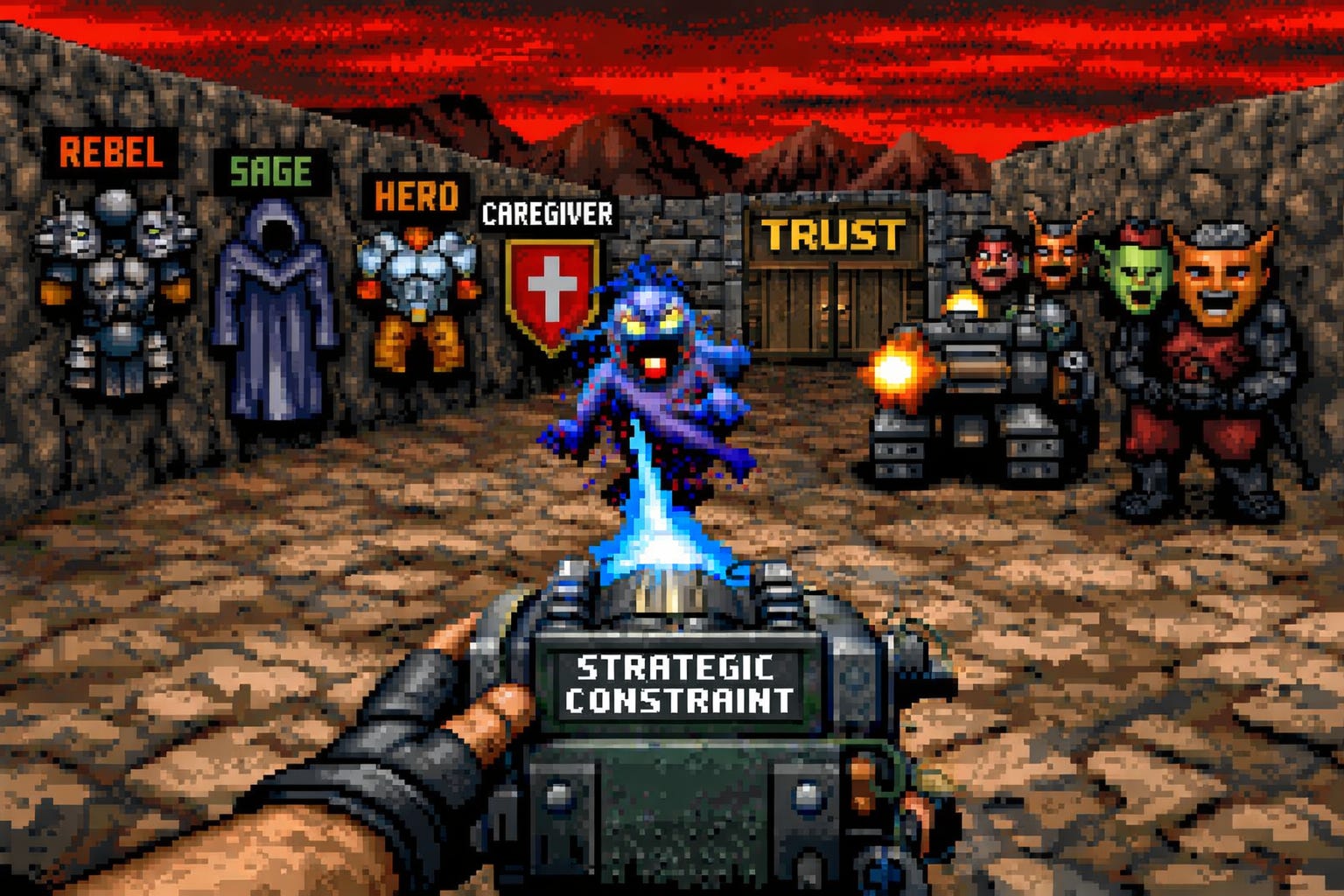
The Rebel attacks the system.
The Sage explains the system.
The Hero overcomes the system.
The Caregiver protects you from the system.
In B2B, this directly affects positioning:
Do you frame incumbents as broken?
Do you frame the buyer as heroic?
Do you frame risk as the enemy?
Do you frame ignorance as the obstacle?
Take these examples:
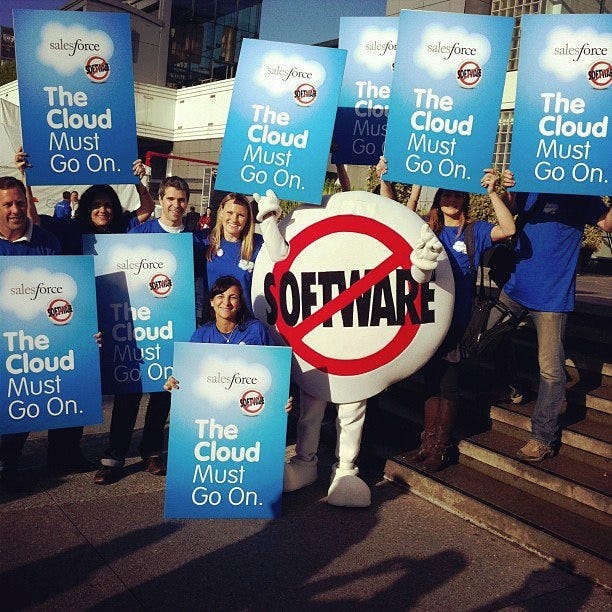
Hero archetype – Salesforce in early SaaS
Salesforce framed CRM as a battle against on-premise software. The “No Software” campaign wasn’t just anti-Oracle theatrics. It positioned buyers as forward-thinking champions modernizing their org.
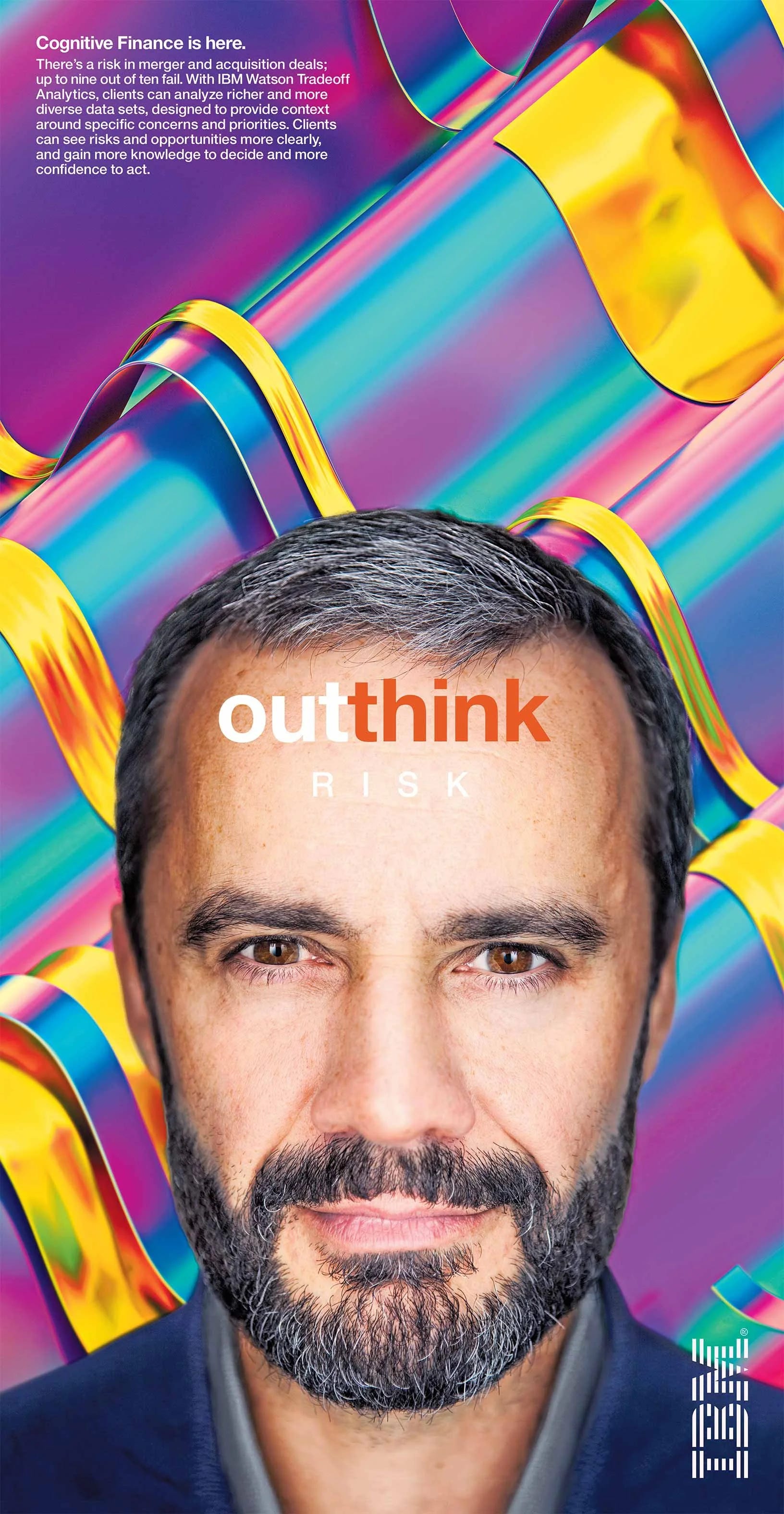
Sage – IBM in enterprise AI
IBM positions itself as the explainer of complexity. Especially with Watson-era messaging, the narrative was about understanding, structuring, and operationalizing intelligence.
Without this clarity, messaging oscillates between tones. And.. markets punish incoherence.
2. Archetypes Shape Risk Signaling
In complex B2B, brand is a proxy for risk.
If you’re selling infrastructure, security, compliance tooling, or core workflow systems, buyers subconsciously ask:
“Is this vendor reckless or stable?”
A Rebel archetype in fintech infrastructure signals very differently than in developer tooling.
Archetypes define:
How bold your claims are.
How aggressive your comparisons are.
How you speak about incumbents.
Whether you market disruption or continuity.
Misalignment here destroys trust faster than bad design.
3. Archetypes Constrain Product Expression
Most teams isolate brand from product.
That’s a structural error.
If you claim to be The Guide or The Sage, your product must:
Teach.
Reduce ambiguity.
Provide structured clarity.
If you claim to be The Hero, your product must:
Empower agency.
Surface progress.
Celebrate wins.
Archetypes create product obligations.
Example:
Notion as The Creator
Notion built its brand around flexibility and user creativity.
That archetype required product obligations:
Modular building blocks
Visual customization
Templates that feel generative
If Notion shipped a rigid, locked-down UI, the brand promise would fracture.
4. Archetypes Prevent Narrative Drift at Scale
As companies grow:
New marketers reinterpret messaging
Sales decks diverge
Agencies invent their own voice
Product marketing optimizes locally
Without a narrative constraint, entropy wins.
Look at:
Nike as The Hero
Nike has maintained a consistent Hero archetype for decades. From “Just Do It” to campaigns featuring Colin Kaepernick, Serena Williams, and everyday athletes.
The tone evolves.
The archetype doesn’t.
That consistency enables:
Global campaigns
Category expansion
New product lines
Without the Hero constraint, Nike becomes just another apparel brand.
Archetypes compress infinite creative options into a bounded strategic field.
That is their real value.
Example
A deep-tech infrastructure company selling data compliance tooling positioned itself as a Rebel.
Website headline:
“Compliance is broken. We’re here to tear it down.”
But their buyers were:
Regulated financial institutions
Enterprise data teams
Risk-averse procurement committees
In sales calls, reps softened the messaging immediately.
“We’re not actually trying to disrupt your entire architecture.”
“We integrate with existing systems.”
Marketing said revolution. Sales said continuity.
That misalignment was archetypal.
We shifted to a Sage/Guardian posture:
Reframed compliance as an optimization problem
Emphasized audit trails and operational defensibility
Rewrote case studies to highlight stability, not disruption
The product didn’t change, but narrative physics did.
Win rates improved (hypothetically) because perceived risk dropped.
The Test
Brand archetypes are useful for you if:
Your messaging feels inconsistent across channels.
Sales reframes marketing claims constantly.
Your category is crowded and language sounds interchangeable.
You’re moving upmarket and trust matters more.
Internal teams debate tone more than strategy.
They are useless if:
You treat them as copywriting inspiration.
You use them without connecting to positioning.
You never translate them into product and sales behavior.
You refuse to make trade-offs.